
Twinkle Troughton
Residency Artist 2026
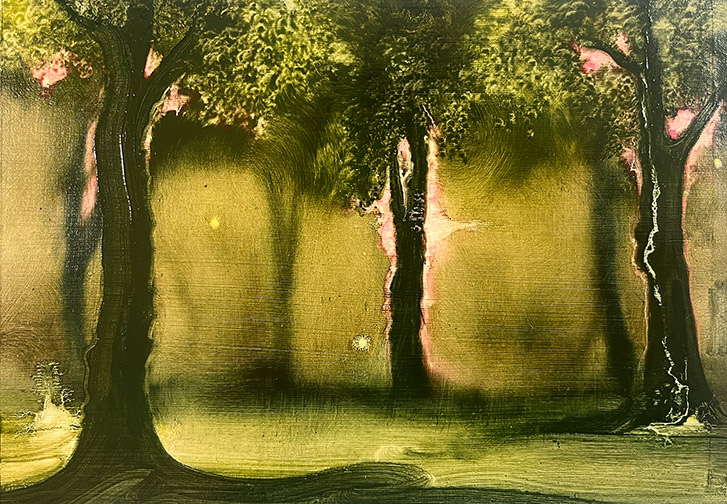
Occlusions of the City Forest
Residency Presentation
Exhibition: 20 – 28 February 2026
Occlusion: The continued radial growth of new wood, including wound wood, which gradually grows over wounds to the woody parts of trees
(A – Z of tree terms: A companion to British Arboriculture).
Occlusions of the City Forest is the culmination of a three month residency at Standpoint during which time Margate based artist Twinkle Troughton explored the history, physical presence, and her own personal connection to the trees inhabiting Hoxton Square, one of London’s oldest garden squares.
Having lived in the area throughout her 20s, the trees in Hoxton Square were already familiar to Troughton. They are the trees she had often sat beneath socialising with friends, or frequently passed by on her way to rehearse with punk band The Fairies Band, or going to parties and private views. Driven by a DIY ethos, these were formative, chaotic and creative years for her.
Now, Troughton’s practice is driven by a fascination with the myth of the English landscape, as she traces the history of trees and animals that inhabit the land to tell another story of England. Coming back to revisit the trees twenty years on, she had never considered their origin, until now.
Hoxton Square’s trees were planted in the early 1700s by local residents who wanted to improve the location during a period of decline, something the square has experienced many times over the centuries.
The predominant tree growing there is the London plane, discovered in a 17th century nursery owned by famous tree hunter John Tradescant the Younger. It is an accidental hybrid tree of the American sycamore and the Oriental plane and due to its resilience to pollution, its now the most populous tree throughout London. It has been exported globally growing in cities around the world.
The London Planes of Hoxton Square
A brief history by Twinkle Troughton.
View or download the PDF
(2 pages, 55 KB)
Like much of the UK’s flora and fauna, the tree’s origin brings together stories of empire and colonialism, but also stories of ecological healing and hope, imbuing it with a duality between light and dark.
Troughton’s paintings don’t serve as illustrations of history, but rather seek to embody this beguiling duality of light and dark within the natural world. Her use of corrosive techniques with oil paints distort and dissolve the image from within, as she reveals luminosity from the dark hues on the canvas. She says:
"I refrain from introducing white paint to the palette, and instead achieve luminosity through the removal of pigment — creating light by stripping away darkness."
"I develop landscapes which begin with places I have been to, and morph into a land of make believe — reflecting both their dark beauty and their layered, constructed existence as ‘idylls’ of the natural world. Oil paint, linseed oil, and solvents bring about moments of decay and un doing — the drip of paint allowed to run, the alchemical reactions of seeping and distortion — and mirrors a fragility in nature, the chaos beneath the order, and the histories embedded in these landscapes."
For the exhibition, Troughton presented a series of paintings reflecting what she had seen, felt and learnt during her residency at Standpoint and her return to Hoxton.
Standpoint residencies facilitate artist development and enable the production of new work in a supportive environment, encouraging artistic exchange and collective working. The residencies are designed to be flexible and responsive to the projects, needs and desired outcomes of individual participants.
This residency is supported by The Fenton Arts Trust and is in partnership with City & Guilds
Twinkle Troughton (b.1978) lives and works in Margate, UK. She completed an MA in Fine Art at City & Guilds of London Art School in September 2025. In 2023, Twinkle was shortlisted for the Contemporary British Painting Prize. Solo shows include Paper Gallery in Manchester and Ramsay & Williams in Margate. In 2013 Twinkle was invited to exhibit and participate in an artist residency with Tinsel Edwards at Galerie Michaela Stock in Vienna, and in 2010 was selected to exhibit as part of an emerging British art show at Redbull’s prestigious Hangar 7 Gallery in Salzburg.
